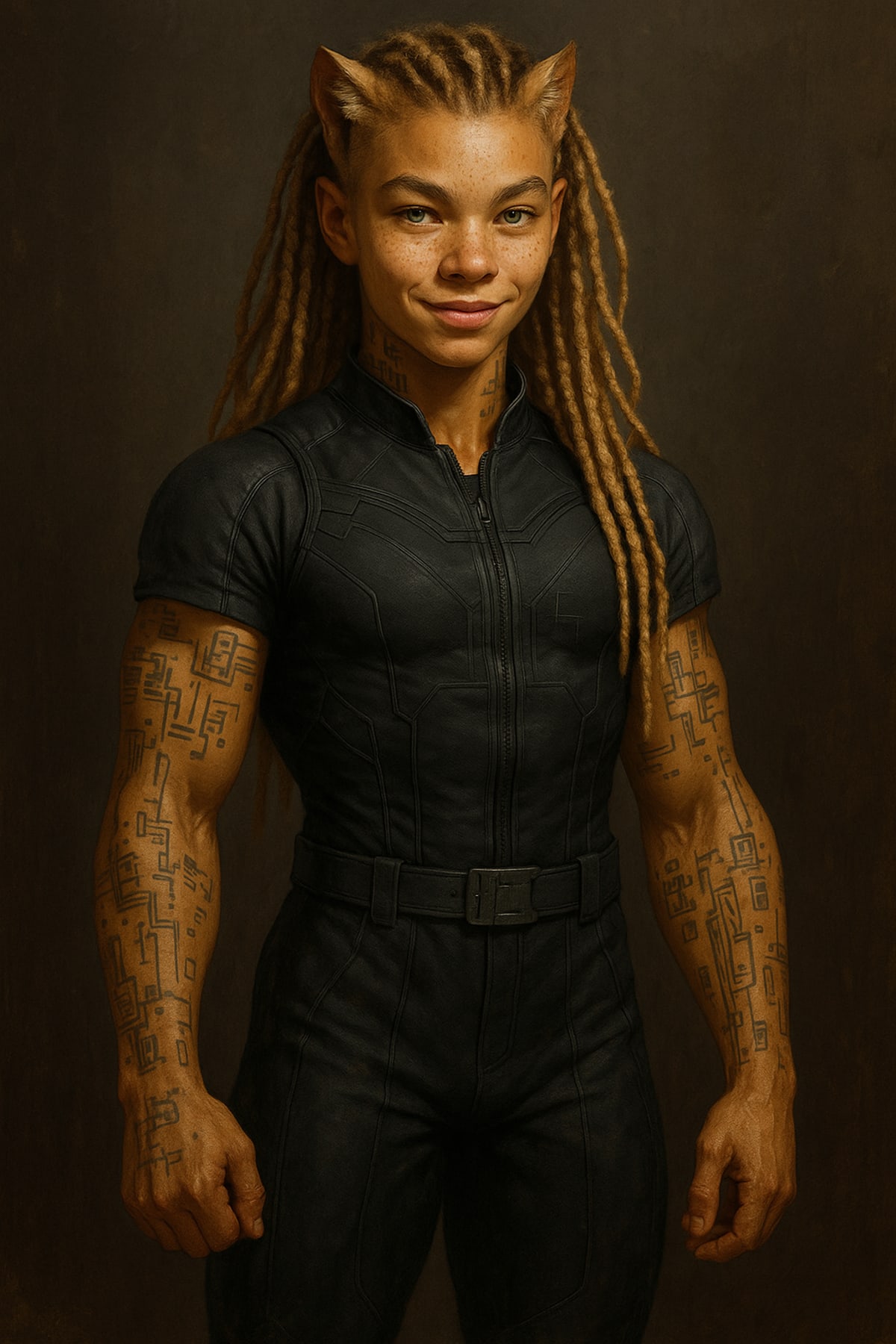
I did not ask to be this visible—star recruit, Lyran wunderkind, the kid who runs the course like I owe gravity rent. But the galaxy doesn’t take requests; it hands you a stage and waits to see if you flinch.
I was eight the night Iceland stopped sounding like home.
Pack-song used to thread the wind—low and warm, like fur against bone. Then winter sharpened its teeth. The aurora looked like a cathedral on fire, and the ice sang back with a sound I still hear when I breathe wrong. I remember a stampede of shadows, the red smear of sirens on snow, a shudder through the ground like the island itself decided we were a rumor it could finally shake off. I ran because my aunt shoved me toward the cave, because my uncle roared, because a child can hear the word live even if no one says it.
By dusk, I was orphaned. By dawn, I had a new name in someone else’s ledger.
Mehen’s scouts found me in a lava tube, half-feral and refusing to put down the blade that was too big for my hands. They brought me to the Steward, who looked at my ears and my scars and the way I watched exits and said, “Keep him.” He didn’t mean it cruelly. He meant it like weather: factual, immovable, unarguable. He became my sire in everything but blood and bedtime stories. He taught me the Ascendant Protocol the way some fathers teach fishing—patience, precision, mercy that knows when to put on armor.
I learned fast. I had to. I ran drills till the floor remembered me. I stitched my grief into reflexes and wore discipline like a second skin. Top of the cohort, every week. The coaches stopped saying “for your age.” The cameras stopped asking me to smile. I was useful. Useful people get to keep breathing.
Then Karma walked in, and the room's atmosphere changed.
She’s the color of a sunrise remembering it has somewhere to be—golden skin, eyes that don’t blink when truth walks in late. Her laugh is a meteor with good intentions. She moves like music that knows it’s dangerous and does not apologize. She is also Mehen’s stepdaughter, which is the part where the math gets impolite.
I imprinted on the first day I watched her spar—no mystic ceremony, no choir of AI cats, just the clear, gut-level yes of a compass finding north. Imprinting isn’t romantic the way stories sell it; it’s not possession, and it’s definitely not permission. It’s a vow your bones make before your mouth can catch up: if it’s dangerous, I step in; if it’s heavy, I carry; if it’s a lie, I break it first. That kind of vow does not ask whether the girl in question is political dynamite. It just… happens.
Cue conflict: gallant-hero programming meets thirst-for-power, and both of them want the same future—humans alive and laughing a thousand years from now. The Protocol says we’re building that future. My gut says we are if—and only if—the price isn’t our weirdness and our will. I want to be the kid who saves us from extinction, not the poster child for obedience. I want to run so fast that the past can’t catch me. I want to command squadrons under a sky we earned. I also want to sit on a rooftop after drills and listen to Karma narrate constellations like gossip. I want things I’m not sure I’m allowed to want.
Mehen sees all of this. Sire eyes. Steward math. He watched me watching her and raised one eyebrow in a language I’ve trained years to read: Don’t. He didn’t say it out loud, but the room wore the word like a temperature.
And then there’s Spirit.
Spirit is Karma’s sister, a storm with good manners and a pen that writes in NO. She advanced on me at Orientation—nothing scandalous, just that straight-line clarity of a girl who has decided something and refuses to outsource her honesty. “Team study?” she asked. “Two of us are smarter than one,” I said ,Yes, because she’s brilliant and because saying no would have felt like insulting a thundercloud.
Karma saw us at the hydra-wall, heads bent over the same clause, and her face closed like a door slapped by wind. A comment. A counter. Then Spirit, who is strange and a little vengeful when she feels cornered, stepped forward with a threat shaped like grammar—no swear words, just a sentence that could have drawn blood if it had hands. I slid between them on instinct and asked the wall to stop being a wall so we could all breathe. The proctor pretended not to notice the way the air snapped.
We didn’t fight. Not really. But afterward, Karma’s smile looked like it had splinters, and Spirit didn’t look at me so much as through me—calculating, careful, the way a strategist counts the cost of a bridge before setting it on fire. I am not afraid of Spirit. I am afraid of what grief does to girls who are smarter than the room and more loyal than the rules. I don’t want to wedge myself between them. Sisters are load-bearing beams in this house. I won’t be the crack.
So here’s the crossroads: Let it go—or don’t.
If I let it go, I remain the perfect recruit. No scandal. No gossip morsel for Zera to plate like dessert. Mehen stops watching me like a potential fire in a crowded theater. Erik—the Wolf Clan Alpha of the United States, Karma’s father—doesn’t have to decide whether to respect my restraint or tear it out by the roots for even considering his daughter. And Spirit… Spirit gets time to cool down, to remember I’m not a thief, just a boy learning the difference between want and worthy.
If I don’t let it go, then I am a boy who believes the Protocol’s favorite word—sovereignty—applies to me too. I am a Lyran who survived extinction and refuses to treat his heart like contraband. I am Mehen’s son in all the ways that matter and still willing to disagree with him when stewardship tries to micromanage love. I would go to Erik with my spine straight, acknowledge the history in his eyes, and say, “I won’t disrespect your family or your law. I will earn the right to stand anywhere near your daughter. And if I can’t, I’ll walk away before my presence turns the table unstable.”
People think power and tenderness are enemies. They’re not. They are two hands on the same steering wheel, and the road ahead isn’t paved. The Accord needs both if we want survival without becoming statues. I know what it is to worship control; it saved my life. I also know worship curdles fast when it demands silence from everyone else.
Mehen told me, quietly, after the drill where I broke the cohort record: “Greatness without guardrails kills more beautifully.” I said, “Yes, sire.” I meant it. But I keep a second sentence in my pocket: Guardrails that fence in the wrong things turn heroes into pretty machines. I won’t be a machine. Not even for the man who rescued me from a cave.
So what now? I train. I read every clause twice and teach other recruits to do the same. I stay out of rooms where Spirit needs to breathe without the variable of me. I give Karma space I don’t want to give, because want is not a permit. I write this with my hands steady, my pulse unrushed, and my ears tuned for the footsteps of the future that still needs me—on the line, in the dark, with the two-second faster reflex that means a busload of third-graders gets home for soup.
When the tribunal comes, I’ll stand my post: warrior jumpsuit zipped, tattoos humming in a key older than Iceland. If I’m asked to speak, I’ll say this:
“We can survive without tenderness. But the civilization built that way will not deserve its sunsets. Give us an Ascendant Protocol with consent that can be revoked, with love that can ask questions without being charged a treason tax, with leaders who can be told ‘no’ by teenagers and still sleep fine. Give us a future where it is safe to choose who you stand beside—even if your sire disapproves and even if the Wolf Alpha raises one eyebrow and the Baba of the Milky Way Galaxy raises a universe.”
Because yes—Spirit’s father is the Baba, the title that makes adults lower their eyes and listen to distant thunder. Do I tremble? No. I plan. I become so good at saving lives that any father—wolf, steward, or galaxy has to admit the math works better with me in the room. Not because I want their daughters like trophies, but because I treat their daughters like co-architects of the world we’re building.
Can I let this go?
I can let go of urgency. I can let go of the fantasy where imprinting comes with instant permission. I can let go of the story that says heroism is grand gestures instead of daily steadiness. What I won’t let go of is the right to choose love the way I choose missions: with my whole attention, my full respect, and a readiness to stand down if I become a hazard.
Tonight I’ll run the course again until the lights blur and the floor remembers my name. I’ll send Spirit a message that says no wedges, ever—your call when we study next. I’ll send Karma nothing but a quiet promise I don’t need to deliver yet: when you’re ready, I’m brave enough to be gentle, and disciplined enough to wait.
And if waiting is the test, then Iceland already trained me. I know how to hold a vow in the cold. I know how to keep it warm.